Introduction
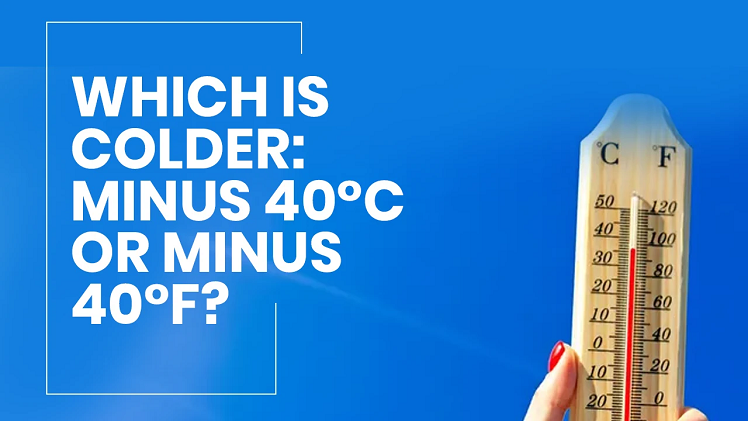
The question “which is colder: minus 40°C or minus 40°F?” has puzzled students, travelers, science enthusiasts, and even professionals for decades. At first glance, the question appears confusing because Celsius and Fahrenheit are two different temperature scales with different zero points, different intervals, and different reference standards. Normally, the same numerical value on these two scales does not represent the same physical temperature.
However, minus 40 degrees is a rare exception. It is the only temperature where both Celsius and Fahrenheit meet at the exact same point. This surprising scientific fact has made the question extremely popular in examinations, quizzes, interviews, and educational discussions.
In this article, the topic will be explained in depth, using clear language, passive voice, tables, and real-world examples. By the end, all confusion surrounding which is colder: minus 40°C or minus 40°F will be fully eliminated.
Understanding Temperature and Measurement
Temperature is a physical quantity that indicates how hot or cold an object or environment is. It reflects the average kinetic energy of particles within a substance. As particle movement increases, temperature rises. When movement slows, temperature decreases.
To measure temperature accurately, standardized scales were created. Over time, multiple scales were developed, but the most widely used are:
Celsius (°C)
Fahrenheit (°F)
Kelvin (K)
For daily life, Celsius and Fahrenheit are most relevant, which is why comparisons between them are often discussed.
What Is the Celsius Temperature Scale?
The Celsius scale is the most commonly used temperature system worldwide. It is part of the metric system and is widely used in science, education, and meteorology.
Key Characteristics of Celsius
Water freezes at 0°C
Water boils at 100°C
Scale is divided into 100 equal parts between freezing and boiling
Used by most countries globally
The Celsius scale is considered logical because it is based on water’s physical properties, which are easy to observe and reproduce.
What Is the Fahrenheit Temperature Scale?
The Fahrenheit scale is primarily used in the United States and a few other regions. It was developed earlier than the Celsius scale and uses different reference points.
Key Characteristics of Fahrenheit
Water freezes at 32°F
Water boils at 212°F
Scale has 180 divisions between freezing and boiling
Offers finer temperature increments
Because of these differences, Fahrenheit values usually appear higher than Celsius values at the same temperature.
Why Do Celsius and Fahrenheit Show Different Numbers?
The difference exists because:
The zero points are not the same
The size of one degree is different
The reference standards vary
As a result, a temperature that feels the same can have very different numerical values depending on the scale used.
The Conversion Formula Between Celsius and Fahrenheit
To answer which is colder: minus 40°C or minus 40°F, temperature conversion must be understood.
Celsius to Fahrenheit Formula
°F=(°C×9/5)+32°F = (°C × 9/5) + 32
Fahrenheit to Celsius Formula
°C=(°F−32)×5/9°C = (°F − 32) × 5/9
These formulas allow accurate conversion between the two scales.
Converting Minus 40°C to Fahrenheit
The conversion of −40°C to Fahrenheit is performed as follows:
°F=(−40×9/5)+32
°F = (−40 × 9/5) + 32
°F=−72+32
°F = −72 + 32
°F=−40
°F = −40
Result
✔ −40°C equals −40°F
Converting Minus 40°F to Celsius
Now, the reverse conversion is applied:
°C=(−40−32)×5/9
°C = (−40 − 32) × 5/9
°C=−72×5/9
°C = −72 × 5/9
°C=−40
°C = −40
Result
✔ −40°F equals −40°C
Final Answer Explained Clearly
Which Is Colder: Minus 40°C or Minus 40°F?
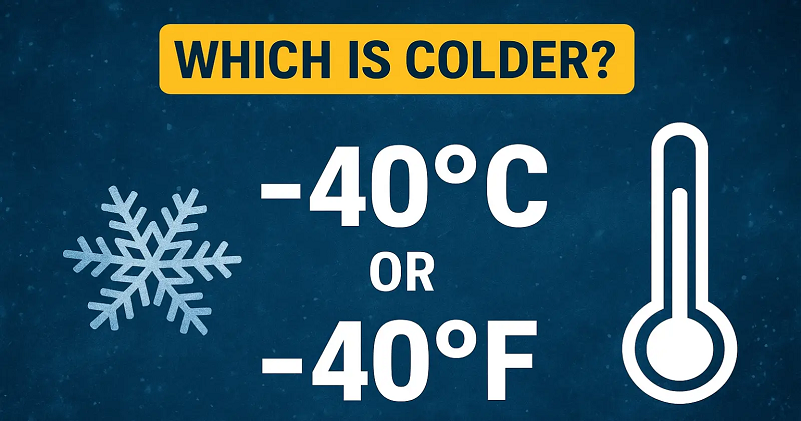
👉 Neither temperature is colder.
👉 Minus 40°C and minus 40°F represent exactly the same temperature.
This is the only temperature point where both scales intersect.
Why Minus 40 Is a Unique Temperature
Minus 40 is mathematically unique due to the ratio between the Celsius and Fahrenheit scales.
Fahrenheit degrees are smaller than Celsius degrees
The offset between zero points causes a crossover
At −40, both scales align perfectly
No other temperature shares this property.
Temperature Comparison Table
| Temperature Description | Celsius (°C) | Fahrenheit (°F) |
|---|---|---|
| Water Freezing Point | 0°C | 32°F |
| Cool Weather | 10°C | 50°F |
| Room Temperature | 25°C | 77°F |
| Human Body Temperature | 37°C | 98.6°F |
| Extreme Cold | −40°C | −40°F |
| Absolute Zero | −273.15°C | −459.67°F |
How Cold Is Minus 40 in Real Life?
Minus 40 is classified as extreme cold and poses serious risks.
Effects on the Human Body
Frostbite can occur within minutes
Skin exposure becomes dangerous
Breathing cold air may cause lung discomfort
Hypothermia risk increases significantly
Effects on Objects and Machines
Metal becomes brittle
Vehicle engines may fail to start
Batteries lose power rapidly
Fuel lines may freeze
Where Do Minus 40 Temperatures Occur Naturally?
Such extreme cold is commonly experienced in:
Siberia (Russia)
Northern Canada
Alaska (USA)
Antarctica
In these regions, −40°C or −40°F may be recorded during winter months.
Why This Question Is Popular in Exams
The question which is colder: minus 40°C or minus 40°F is often asked because:
It tests conceptual understanding
It challenges assumptions
It requires knowledge of conversions
It is memorable and logical
Students often assume one value must be colder, making it an effective trick question.
Common Misunderstandings Explained
Misunderstanding 1: Fahrenheit Is Always Warmer
This belief is incorrect. Fahrenheit numbers are higher only because the scale is different.
Misunderstanding 2: Negative Celsius Is Always Colder
This is generally true, except at minus 40, where both scales are equal.
Is Minus 40 the Coldest Temperature Possible?
No. The coldest theoretical temperature is absolute zero.
Absolute Zero Explained
−273.15°C
−459.67°F
Particle motion nearly stops
Minus 40 is extreme, but not the lowest possible temperature.
Importance of Minus 40 in Science and Industry
Minus 40 is used as a reference point in:
Physics education
Meteorology
Aviation safety
Engineering design
Climate research
It is often memorized by professionals working in cold environments.
Why Weather Reports Confuse People
Weather apps show temperatures in both scales, causing confusion when values are negative. Understanding that −40 is the same in both systems helps eliminate misinterpretation.
Memory Trick for Students
A simple way to remember this fact:
This trick helps recall the answer instantly during exams.
Frequently Asked Questions (FAQ)
Which is colder: minus 40°C or minus 40°F?
Both are equally cold. They represent the same temperature.
Why do both scales meet at −40?
Because of the mathematical relationship between the two scales.
Is −40 dangerous for humans?
Yes. Frostbite and hypothermia risks increase rapidly.
Is −40 common anywhere?
Yes. It occurs in polar and sub-polar regions.
Is this the only equal point between Celsius and Fahrenheit?
Yes. No other temperature shares this property.
Which countries use Celsius and Fahrenheit?
Celsius is used worldwide; Fahrenheit is mainly used in the United States.
Key Points to Remember
Minus 40°C equals minus 40°F
Neither temperature is colder
This is a unique crossover point
Understanding scales prevents confusion
Commonly tested in exams
Conclusion
The question “which is colder: minus 40°C or minus 40°F?” may appear confusing at first, but the answer is scientifically simple. Both temperatures are exactly the same. Minus 40 stands as a rare and fascinating point where two major temperature scales intersect.
This knowledge is valuable not only for exams but also for understanding weather, science, and global temperature reporting. Once learned, it becomes an unforgettable scientific fact.