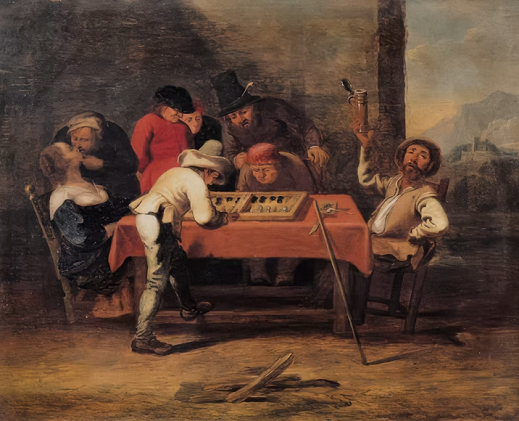
At Versailles, the card table was not entertainment on the side – it was a second throne room. Louis XIV staged nightly games in the Salon de Mars and later the purpose-built Salle du Jeu, and attendance was effectively mandatory for anyone who wanted the king’s attention the next morning. Courtiers who skipped the table for a week could find themselves quietly dropped from hunting parties or left off the guest list for a royal supper.
What made the ritual strange by any modern standard is that winning too consistently was almost as dangerous as refusing to play. A duke who walked away from every game up money looked calculating rather than loyal, so nobles learned to lose gracefully and often. Today the same appetite for structured risk survives in a far more transparent form – platforms such as spinfin let players test card and table strategy against fixed, published odds instead of a courtier’s unwritten social ledger.
The Games of Versailles: Lansquenet, Ombre and Basset
Three games dominated the court calendar. Lansquenet, a fast German import, moved so quickly that a noble could lose a year’s pension in under an hour. Ombre, imported from Spain, rewarded patience and bidding skill, which made it the preferred game among ministers who wanted to look shrewd without appearing greedy. Basset, banned in Paris proper by 1691 for the ruin it caused among the bourgeoisie, kept running openly inside the palace because royal apartments sat outside the reach of city magistrates.
Each game also carried its own etiquette for how a noble was expected to lose. Ombre players spread their losses across an evening in small, controlled bids, while Basset players staked entire fortunes on a single turn of the card, which is why contemporary letters describe Basset nights as louder and more dangerous than anything else on the court calendar.
| Game | Origin | Typical pace | Court reputation |
| Lansquenet | Germany | Very fast | Reckless but fashionable |
| Ombre | Spain | Slow, tactical | Respected, ministerial |
| Basset | Italy | Fast, high stakes | Banned in Paris, tolerated at court |
| Reversi | France | Moderate | Favored by younger nobles |
The unwritten rules governing this economy were consistent enough that historians can reconstruct them from letters and account books:
- Never leave a game holding more winnings than the highest-ranking player at the table.
- Settle debts to the king’s favorites first, everyone else could wait months.
- A public loss to the king himself was worth more socially than a private win against a rival.
- Refusing an invitation to play was read as a political statement, not a personal preference.
Debt as Diplomacy: Why Losing Kept You in Favor
A noble arriving at Versailles with no debts was, paradoxically, a security risk. Debt tied a courtier to the king’s ongoing goodwill, since only royal patronage – a pension, a military post, a marriage arranged by the crown – could realistically cover losses of that scale. Losing money at cards was therefore a way of publicly renewing dependence on the monarch, repeated as often as the schedule demanded. Basset in particular produced staggering single-night swings, and Madame de Montespan reportedly lost the equivalent of several hundred thousand modern euros in one sitting during the 1680s while the king quietly covered the debt from the treasury.
The Winners Who Had to Give It Back
Occasionally a courtier won so heavily that etiquette forced an awkward workaround. The Marquis de Dangeau, famous for tracking odds with near-professional discipline, won so often at Ombre that he began quietly redistributing winnings through gifts and loans to avoid the appearance of profiting off royal company. Dangeau’s diary, one of the richest surviving records of Versailles life, describes this balancing act in blunt terms – he treated his card income almost like a tax he owed back to the social order that let him win in the first place.
Three tactics recur in the memoirs of habitual court winners:
- Passing winnings forward as “loans” that were rarely, if ever, collected.
- Sponsoring a poorer relative’s court expenses to disguise personal profit.
- Deliberately losing back a portion of the same night’s winnings to a higher-ranking player.
When the Treasury Couldn’t Keep Up
By the 1690s the scale of court gambling was straining royal finances directly. War with the League of Augsburg emptied state coffers at the same time nightly losses at Basset kept climbing, and Louis XIV eventually restricted the game to reduce the crown’s exposure to covering noble debts.
The restriction did not end court gambling – it simply pushed the largest stakes into Ombre and private apartments, where the same social logic of obligatory loss continued for another generation under his successors. Account books from the regency years show pensions and gambling debts recorded side by side, as if the crown had finally accepted that the two ledgers were never really separate. What began as a way to keep nobles physically close to the king had, by then, become a permanent fixture of how Versailles financed its own loyalty.