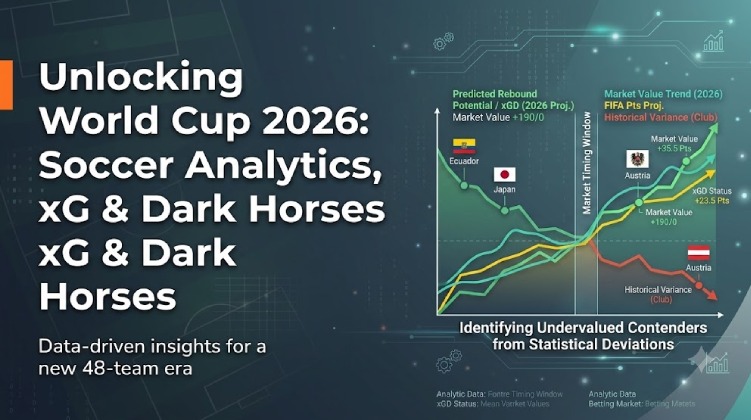
The landscape of international soccer is undergoing a data-driven revolution. Gone are the days when managers and analysts relied solely on the “eye test” or gut feelings to evaluate a team’s performance. As we approach the monumental World Cup 2026 in the United States, Canada, and Mexico, the expanded 48-team format presents a unique mathematical and tactical puzzle.
For football purists, tactical analysts, and those looking to find value in soccer odds, understanding underlying metrics is no longer optional—it is a necessity. A team might win a match 1-0, but did they truly dominate, or were they simply rescued by an extraordinary goalkeeping performance and a lucky bounce?
In this comprehensive guide, we will unlock the secrets of World Cup 2026 through the lens of modern soccer analytics. We will demystify crucial stats like Expected Goals (xG), examine how data predicts sustainable success in a knockout tournament, and utilize these numbers to identify the early dark horses who are primed to shock the world on the biggest stage.
The Analytical Revolution in International Soccer
In club soccer, teams play 38 to 46 league games a season. Over such a massive sample size, luck tends to balance out, and the team with the best underlying statistics usually wins the title. International soccer, however, is a game of extreme variance. A World Cup campaign lasts a maximum of eight games (under the new 2026 format). In such a short sprint, a single contentious refereeing decision, a deflected shot, or a momentary lapse in concentration can eliminate a giant.
This is exactly why national federations and professional soccer analysts are leaning heavily into data. Analytics help strip away the “noise” of luck and variance. By focusing on performance metrics rather than just the final score, analysts can predict future outcomes with a much higher degree of accuracy.
Key Metrics Defining Modern Soccer
To understand the World Cup 2026 landscape, you must be familiar with the holy trinity of modern soccer analytics:
- xG (Expected Goals): Measures the quality of a goalscoring chance. It calculates the probability (from 0.00 to 1.00) of a shot resulting in a goal based on historical data (distance, angle, body part, type of pass).
- xGA (Expected Goals Against): The exact same metric, but applied to the defense. A team with a consistently low xGA is structurally sound and rarely gives away high-quality chances.
- PPDA (Passes Allowed Per Defensive Action): A metric used to quantify the intensity of a team’s high press. A lower PPDA means a team presses aggressively and disrupts the opponent’s build-up play effectively.
Demystifying xG: The Truth Teller of Soccer
If there is one metric that will define the analytical coverage of World Cup 2026, it is Expected Goals (xG). But how exactly does it help us analyze the game better?
Imagine a Group Stage match between a Pot 1 giant (e.g., Spain) and a Pot 4 debutant. The match ends in a shocking 1-1 draw. The global media might declare a crisis for Spain. However, a look at the data reveals:
- Spain xG: 3.25
- Debutant xG: 0.12
Spain generated enough high-quality chances to score three goals comfortably, but suffered from poor finishing or an inspired performance by the opposition goalkeeper. The debutant scored a fluke goal from 35 yards out (a 0.02 xG chance).
For an analyst, the conclusion is clear: Spain’s tactical system worked perfectly. There is no need for the manager to panic or change the lineup. Conversely, the debutant was incredibly lucky and their performance is entirely unsustainable. If you are looking at early soccer odds for the next round of matches, the smart value remains firmly with Spain, while betting against the debutant in their next match offers a logical edge.
xG Difference (xGD) in Tournament Play
The true mark of a World Cup contender is a positive xG Difference (xGD)—which is calculated by subtracting xGA from xG.
| Team Profile | xG Produced | xGA Conceded | xGD Status | Analytical Verdict |
| The Contender | High (>2.0 per game) | Low (<0.8 per game) | Highly Positive | Sustainable dominance. Worth backing in deep knockout stages. |
| The Lucky Survivor | Low (<1.0 per game) | High (>1.5 per game) | Negative | Overperforming their stats. Likely to be eliminated soon. |
| The Unlucky Loser | High (>1.5 per game) | Low (<1.0 per game) | Positive | Playing well but suffering bad variance. Strong bounce-back candidates. |
Identifying the World Cup 2026 Dark Horses
Using underlying metrics from recent continental tournaments, qualifiers, and friendly matches, we can start to paint a picture of which mid-tier nations boast the statistical profiles required to make a deep run in 2026.
A true “dark horse” is not just a fan favorite; it is a team with a solid defensive structure (low xGA) and a clear, repeatable method of creating chances (high xG from transitions or set-pieces). Here are three nations that the data suggests we should keep a very close eye on.
1. Japan: The Masters of High-Speed Transitions
Japan proved in Qatar 2022 that they can hang with the European elite, defeating both Germany and Spain. However, their underlying numbers since then have only improved. Under Hajime Moriyasu, Japan has cultivated one of the most efficient transition attacks in global soccer.
- The Analytical Edge: Japan boasts an incredibly impressive PPDA. They do not press mindlessly; they set deliberate pressing traps in the middle third of the pitch.
- Why They Can Shock in 2026: In the 48-team format, Japan will likely dominate possession in the group stages against weaker opponents. But in the knockouts against teams like Brazil or France, their ability to generate high xG chances from rapid counter-attacks (often requiring 4 passes or fewer) makes them a lethal underdog. They are tactically disciplined and statistically ruthless.
2. Ecuador: The Impenetrable Wall of CONMEBOL
South American qualifiers are notoriously brutal, but Ecuador has consistently produced staggering defensive metrics. Relying on a core of physically imposing, technically gifted young midfielders (led by stars like Moisés Caicedo), Ecuador plays a suffocating brand of soccer.
- The Analytical Edge: Ecuador’s xGA (Expected Goals Against) during high-stakes matches is remarkably low. They deny opponents entry into the “Zone 14” (the area right outside the penalty box) better than almost any non-elite nation.
- Why They Can Shock in 2026: Tournaments are won by defenses. A team that does not concede high-quality chances is virtually impossible to knock out in 90 minutes. With the World Cup moving to North America, Ecuador will be comfortable with the climate and travel. If they can marginally improve their offensive xG conversion, they are prime candidates for a Quarter-Final run.
3. Austria: The High-Octane Pressing Machine
Under the guidance of Ralf Rangnick, the godfather of Gegenpressing, Austria has transformed into a statistical darling. They are no longer a traditional, rigid European side; they are a modern, aggressive, high-pressing unit.
- The Analytical Edge: Austria frequently registers some of the lowest PPDA numbers in Europe. They force high turnovers, which directly leads to high-xG scoring opportunities. A shot taken immediately after winning the ball high up the pitch naturally has a higher xG probability because the opponent’s defense is entirely out of shape.
- Why They Can Shock in 2026: In a 48-team World Cup, many lower-ranked teams will try to play out from the back. Austria’s pressing system will absolutely dismantle teams that lack elite ball-playing defenders. They have the tactical framework to create chaos and capitalize on it.
Finding Value: Soccer Odds and Early Betting Strategies
For those who view the game through the lens of investments and soccer odds, the expanded format of World Cup 2026 offers a unique landscape. The key to finding value is ignoring the “name brand” on the jersey and focusing purely on the data.
1. Fading the False Giants
Historically successful nations often carry heavily inflated odds due to public sentiment. If a traditional giant (e.g., Italy or Germany) enters the tournament with a declining xG Difference in their qualifying campaign, they are vulnerable. The public will bet on their history, driving their odds down. The smart, data-driven analyst will look at their bloated xGA and find tremendous value in betting on their opponents via Asian Handicaps (+1 or +1.5).
2. The Total Goals (Over/Under) Market
With the introduction of the Round of 32, the stakes in the final group stage matches will be incredibly high, but also highly calculated. If two teams only need a draw to secure a “best third-place” advancement, expect a massive drop in attacking intent. Analyzing the xG buildup of both teams leading into Matchday 3 will help pinpoint matches where backing the “Under 2.5 Goals” offers a significant statistical edge.
3. Backing the Underdogs in Knockout Football
When evaluating knockout stage matchups, always look at the underlying defensive stats. If a dark horse (like Ecuador) with a low xGA faces a heavy favorite that relies on individual brilliance rather than structural xG generation, the dark horse has a much higher probability of taking the game to extra time or penalties. Backing the underdog on the +0.5 or +1 Asian Handicap in these scenarios is a classic data-backed strategy.
Conclusion: The Ultimate Test of Soccer Intelligence
The World Cup 2026 will not just be a festival of soccer; it will be the ultimate proving ground for soccer analytics. The sheer volume of matches, the diversity of the 48 participating nations, and the grueling travel schedule mean that luck alone will not carry a team to the trophy.
By embracing metrics like xG, xGA, and PPDA, we can cut through the emotional narratives that dominate traditional sports media. We can appreciate the tactical brilliance of a team that creates high-quality chances, even on the days their strikers misfire. And most importantly, we can identify the early dark horses who are quietly building statistically elite profiles away from the mainstream spotlight.
As we count down to the opening match, remember: the ball is round, and anything can happen in 90 minutes. But over the course of a 104-match tournament, the numbers rarely lie. Keep your eyes on the data, analyze logically, and enjoy the tactical evolution of the beautiful game.